We spoke with the Audrey Neveu, People & Culture track lead, to find out what’s happening in 2026. Head HERE for a full list of sessions in the Languages track in this edition.
We talk a lot about technology at Devoxx UK, but this track focuses on people and cultural topics. Why are those conversations more important than ever right now?
Probably because it’s the only track where we can discuss our most precious team asset: people. Technical choices are important, of course, but technology is just a tool, and technical problems can easily be fixed. Having the right people in your team and creating an environment in which they can grow and perform safely is a whole different level of complexity.
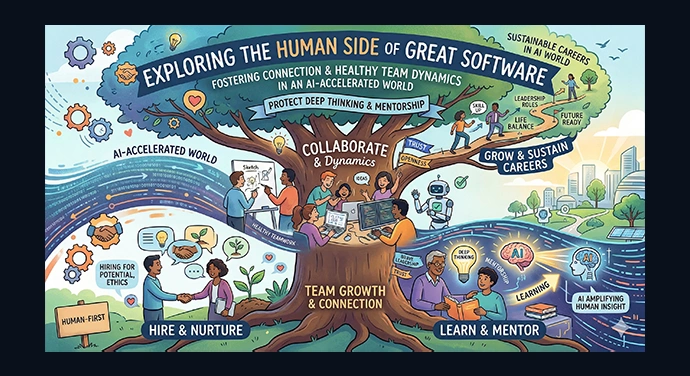
In this track, we discuss mental health, teamwork, mentorship, team management, career ownership, recruitment and more. All of these discussions are impacted by AI, which creates a lot of stress for individuals. This is why now, more than ever, we need to have these discussions if we are to find ways to navigate this new level of complexity.
What themes stood out when reviewing submissions for this track?
Interestingly, it was a mix of the themes mentioned above and the multiple impacts of AI on our industry. Compared to last year, for example, there is a clear difference in the maturity of AI submissions, which shows that the industry is gaining knowledge and experience in dealing with AI agents in its day-to-day work. However, it’s clear that AI won’t solve every problem. Burnout and impostor syndrome are still hot topics, and we can even imagine that AI may exacerbate them in the future. On the other hand, some topics need to be completely re-addressed because of AI, such as recruitment and team management.
How is the role of developers changing in an AI-accelerated world?
This will be the heart of discussions in the People & Culture track this year. Even though it’s a work in progress and will probably continue to evolve, it seems that we’re moving from an end-to-end executor role to an architect/controller position. It’s very unlikely that you’ll write every single line of configuration files or unit tests individually; it’s more likely that you’ll instruct your agent to implement them and then ensure that they’re done the way you want before moving forward.
How do we make sure AI amplifies human output and creativity rather than replacing it?
In my opinon, the only way to achieve that is by treating AI as yet another tool, not another coworker. I think most people need to keep the crucial parts of the job because that’s where the fun is! The magic of this job lies in designing beautiful architectures and solving issues with elegant code, not writing effective prompt.
And even if AI is treated as a tool, it should not be done blindly. We see companies pressuring workers to use AI, even creating new metrics around its usage to measure individuals’ performance, which causes stress and demotivation. However, the initial feedback from large companies that have been using it for over a year is that it neither improves code quality nor overall team productivity.
That’s the reason why I’m expecting a lot from this year’s selection because this was the underlying question present in many submissions. Hopefully, our speakers will be able to provide our attendees with some practical tips on this topic.
What does a sustainable long-term career in tech look like now?
I would love to know, but the truth is: I have no idea! To be honest, that’s not what worries me the most. I’m much more concerned about the lack of opportunities for junior developers today, because I think an industry that doesn’t invest on its juniors is setting itself up for a very difficult future.
What are the best things about Devoxx UK generally?
Devoxx UK is one of the few conferences that is both warm and safe. It’s warm and cosy because it’s big enough to allow you to meet new people without feeling overwhelmed. It’s also safe because diversity has always been at the heart of the conference. As a speaker or an attendee, you can literally be yourself without fear — those places are rare today.
VIEW ALL OF THE SESSIONS IN THE PEOPLE & CULTURE TRACK HERE