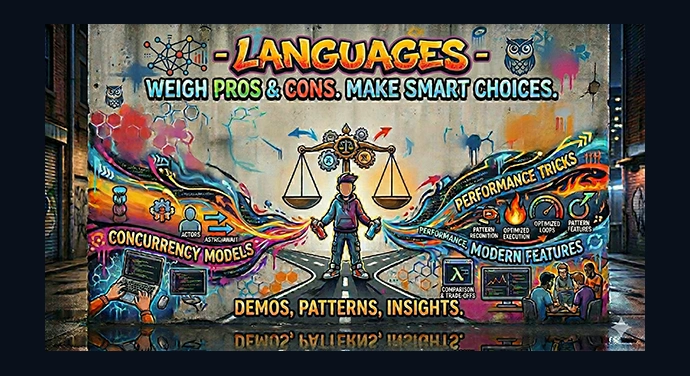
We catch up with Carly Richmond to see what’s coming up in the Languages track at Devoxx UK 2026. Head HERE for a full list of sessions in the Languages track in this edition.
When reviewing the session submissions, did any themes stand out across different languages?
It was great to see such a diverse set of submissions this year. That makes my job as a reviewer interesting. There were 3 distinct themes across the submissions this year:
- Running various different languages on the JVM. For some years discussion of Scala, Kotlin and Clojure has been common, but seeing execution of traditional non-JVM languages such as Python and also other paradigms such as scripting was rather interesting.
- AI (no surprise there) did feature, but not in the way I initially expected. Rather than engineers talking about leveraging AI to select languages or write code in unfamiliar languages, the submissions focused on running AI models natively in the browser, or via frameworks supporting JVM languages.
- Language features and capabilities that Java can learn from other languages, particularly Rust and Kotlin.
How should developers think about choosing a language for a new project today?
Developers are increasingly leveraging LLMs to ask questions about which language or technology they should use to solve problem X. AI makes language choice more murky, as you can argue that we can now generate code for unfamiliar languages using the help of LLMs. I was always taught pick the right language for the problem based on the domain, platform, performance considerations and the capabilities of the team. We still need to remember to that any code we generate in unfamiliar languages much be idiomatic, human-readable and supportable by us, irrespective of what is recommended.
What modern language features are having the biggest impact on how developers write software?
Memory safety considerations are one factor of languages, if you consider the borrowing principal in Rust. The ownership principal is certainly a big advantage to help developers avoid the common memory issues I still have nightmares about from writing C and C++ and university.
Overhauling how we handle concurrency is another language feature that is undergoing change. Trends such as Virtual Threads from Java (Project Loom) and Goroutines (Go) allow for lightweight, scalable concurrency without the heavy overhead of OS threads. I still am of the opinion that we should always think twice when writing concurrent code, but tools to scale concurrent processes when we need to are a good thing in my view.
Data-oriented programming is still a prominent feature in my view. Chatter about capabilities such as Java records and sealed classes has calmed. But given I see our role evolving to focus on ensuring agentic systems have the right data, these features feel like an essential backbone for me in writing self-documenting code outlining data flow and transformation.
Do you think languages are converging on similar ideas, or are they diverging more than ever?
For me I would say converging. A key example for me in recent years would be the pattern of signals in the JS world. When it appeared in Knockout.js, Backbone and Angular all around the same time, it didn’t take too long for others to follow similar patterns. But I see that as an advantage as it makes it easier for developers to pick up the right language for the problem, and encourages learning.
How do you see AI influencing the way programming languages evolve?
In the short-term I’m not sure syntax will drastically change, and instead we’ll see more of a convergence of syntax. This mimics the view of languages that I’ve seen in recent years with similar syntax and features in many programming languages, from Java to C# and even Typescript. What could be interesting is whether the recommendations LLMs make on language and technology choice lead to particular languages being phased out. Every few years people talk about language X being dead, only to come back with a joyous resurgence, and I do wonder if LLM suggestions will lead to us all picking the same technologies all the time. Time will tell!
You’ve been at Devoxx UK as an attendee, a speaker, a sponsor and a member of the content review team. What is it about Devoxx UK that keeps you coming back?
People keep me coming back. The speaker pool and review team are amazingly smart and friendly individuals that I enjoy learning from and connecting with year after year. Community connection is so important to me, and the strong community at Devoxx UK is a great one to be a part of.
INTERESTED IN LEARNING MORE? REVIEW THE LANGUAGES TRACK HERE